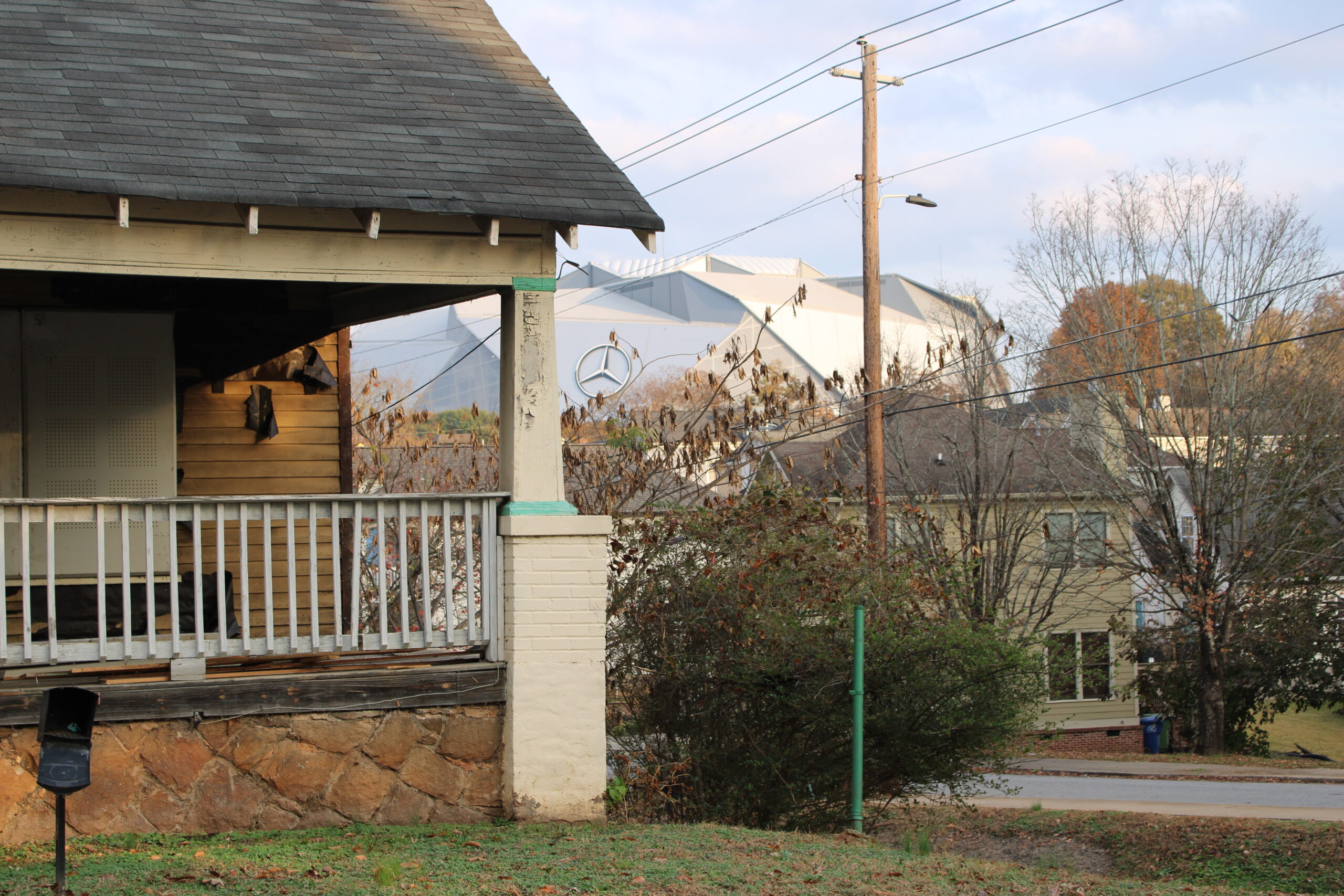
Mercedes-Benz Stadium is visible in the skyline from Atlanta’s Vine City neighborhood. (Chauncey Alcorn/Capital B)
The Black Seniors Who Remember Atlanta Before the Stadiums
Longtime residents say decades of redevelopment have changed Southwest Atlanta in ways that can only be seen across a lifetime.
Tillman Ward, 80, recalls his father building him and his siblings a home on Chestnut Place in Vine City in southwest Atlanta during the 1950s.
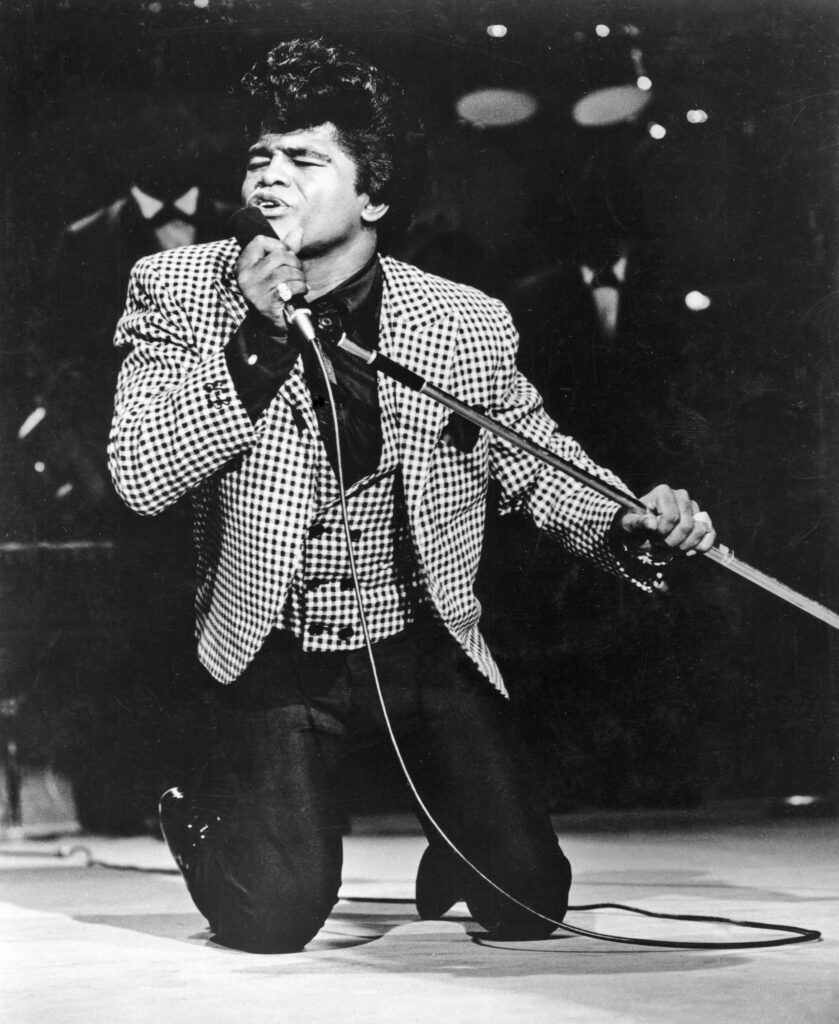
He remembers watching Martin Luther King Jr. walk from his family’s home on Sunset Avenue to his office on Auburn Avenue, and stars like Chuck Berry, James Brown, and Ray Charles performing at the Magnolia Ballroom.
“This is where yesterday meets tomorrow,” Ward often tells visitors touring historic Vine City. “Some of the people who’ve made great impact locally, regionally, nationally, and internationally, either worked here, lived here, had an office here, [or] entertained here.”
The retired Nabisco sales and marketing representative has owned his own home in the neighborhood for more than 30 years. But now so much has changed, that it’s not clear how much longer he can hold on.
For decades, Black families in Atlanta’s Vine City, and other southwest Atlanta neighborhoods, have endured forces of gentrification that have threatened to break up their proud communities and already uprooted Black families in other parts of the city.
Southwest Atlanta is the last stand, the largest concentration of Black people in Atlanta, after most of Atlanta’s east and much of its southeast sides have lost Black residents. But as higher-income people come to the city, including Black people from other parts of the country, rents and taxes are rising.
Seniors who’ve been here for generations say it’s increasingly difficult to afford their homes. Some say current strategies to combat their displacement are similar to previous failed efforts and are unlikely to succeed.
Too often the voices of those who are the most impacted aren’t heard, and their community’s history is being lost.
As the World Cup plays out in Atlanta, there has been talk that the games, taking place in the community at Mercedes-Benz Stadium, could create an economic boom. But talk of neighborhood revitalization efforts and the World Cup have reminded many legacy Southwest Atlanta residents — those who have lived in the city for more than a decade — of broken promises of the past.
Many of Ward’s Black former neighbors have since sold their houses to institutional investors who have spent years calling Ward trying to acquire his home as well. Rising property taxes have made the offers tempting for Ward, who lives on a fixed income like many retired seniors.
“When I run behind on my taxes, some people [call from] out of state, sometimes out of the country, saying, ‘Would you like to sell your vacant property?’” Ward told Capital B Atlanta. “People who are used to paying higher taxes from other places don’t mind coming. And sometimes they come knowing you’re being displaced.”
Vine City, once a thriving Black community, is one of many Atlanta neighborhoods that have seen their legacy Black population decline over the past two decades. Since 2010, the Black population has fallen 8% in the area located west of Mercedes-Benz Stadium between Martin Luther King Jr. and Joseph E. Boone boulevards, according to an Atlanta Regional Commission analysis.
Rent prices in the neighborhood have risen 65% to 100% since 2010, according to a 2025 Georgia Tech study, which revealed 40% of Vine City residents live below the poverty line. Amid rising rents, Black-owned businesses and single-family homes occupied by Black families have been torn down or repurposed and replaced by commercial development and apartment complexes.
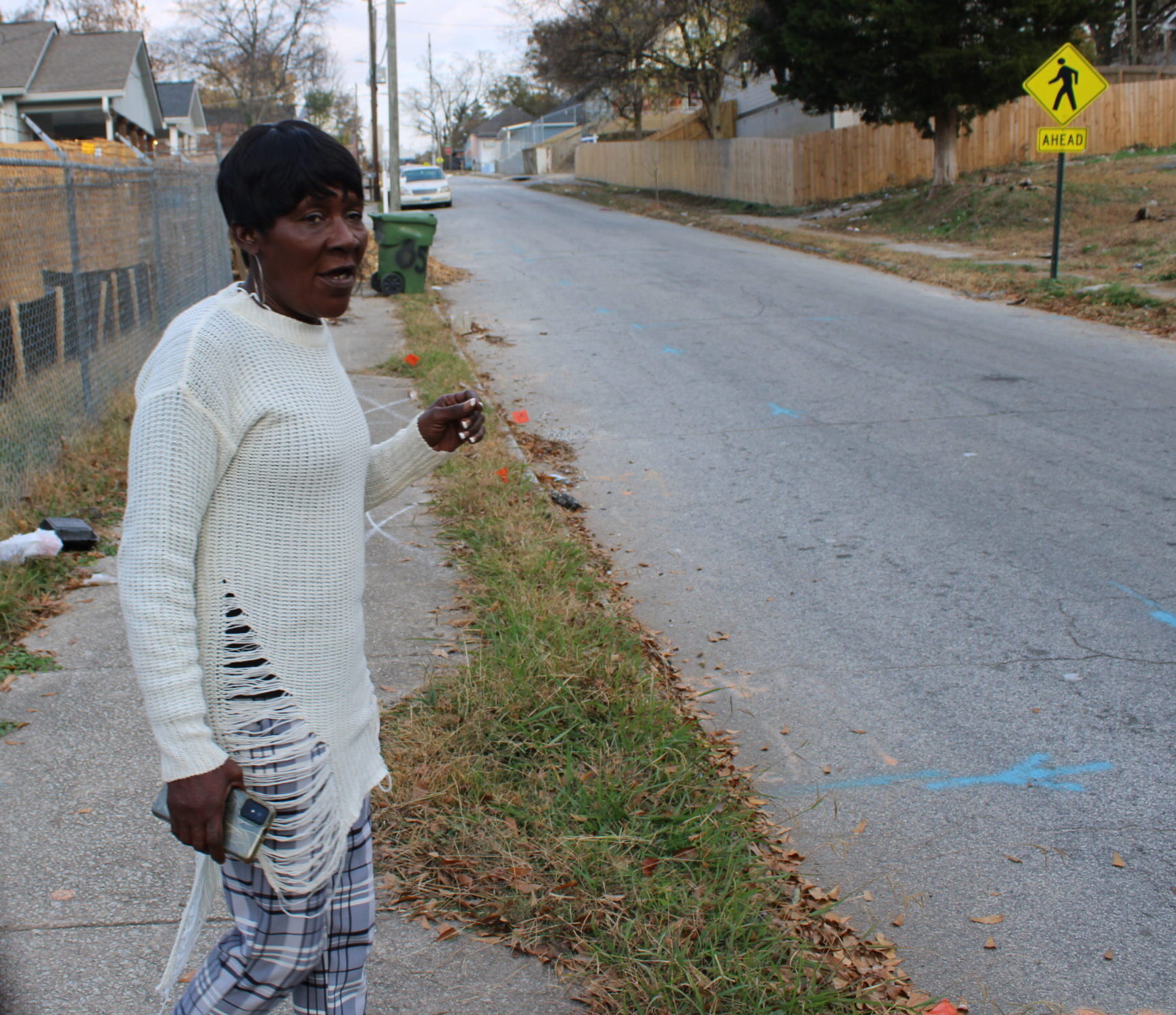
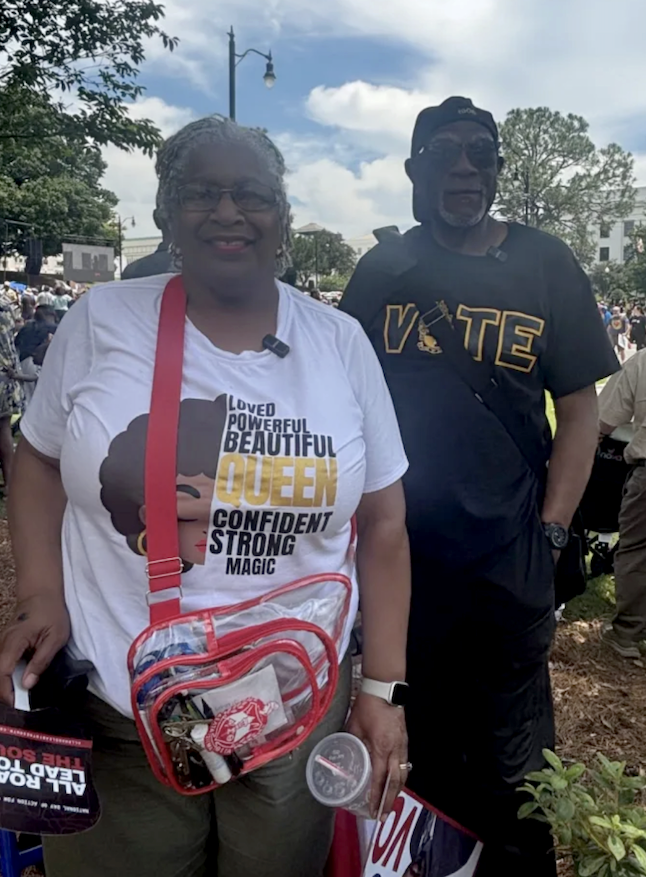
Vine City resident Alma Lott said Mercedes-Benz Stadium has fueled gentrification in the west Atlanta neighborhood where she says many of her low-income Black neighbors have been forced to move out or be homeless due to rising rent prices. (Chauncey Alcorn/Capital B)
Alma Lott, who has lived in the shadow of Mercedes-Benz Stadium since it first opened 16 years ago, has struggled to accept and cope with the changes in her neighborhood.
The 56-year-old cofounder of Teens of 2morrow — a social justice nonprofit that advocates for fair housing practices and economic empowerment for Atlanta youth and legacy residents — has also seen many of her low-income, Black neighbors move away due to rising rents and stagnant wages.
Some, she said, have been forced into homelessness. She’s one of the remaining renters who have lived in the neighborhood more than three decades.
“A lot of families are on the streets because we don’t have no way of finding out information [on] how to keep families inside the community,” Lott told Capital B Atlanta. “We’re just in a bind now.”
Commitments to bring economic growth to Vine City have failed to fully materialize, and some efforts have had the opposite effect.
Some Atlanta residents have recalled city leaders and developers telling Black locals that major infrastructure projects — like the construction of Centennial Olympic Stadium in Summerhill ahead of the 1996 Olympic Games and the Georgia World Congress Center downtown — would be a boon for native Atlantans in historically Black communities.
But the economic condition for many Black residents there has remained the same despite rising rents and property taxes.
Nine months ago, Mayor Andre Dickens unveiled his plan to create economic growth in southwest Atlanta by extending eight Tax Allocation Districts, or TADs, due to expire over the next five to 13 years. Tax Allocation Districts are economic tools that set aside funds gained from property tax increases to pay for public and private development projects in neglected areas.
The mayor recently walked back plans to extend eight existing TADs following pushback from Black community activists, including Rodney Mullins, co-founder of West Atlanta Progress, an economic development nonprofit, because of fears they would amplify gentrification.
Gentrification stemming from Mercedes-Benz Stadium is what motivated Mullins, 50, to create West Atlanta Progress in 2022. His organization operates in southwest Atlanta neighborhoods, including Cascade, English Avenue, and Vine City.
The former national consumer advocate for President Barack Obama said low-income Vine City residents were told they’d get an economic boost once Mercedes-Benz Stadium opened.
He recalled the creation of Atlanta’s Westside TAD in 1992 and Stadium Area TAD in 2006. The Westside TAD was created around Mercedes-Benz Stadium. The Stadium Area TAD was created around Turner Field. The pitch made to Black locals at the time was to support using future property tax revenue to help pay for infrastructure and private development projects that would bring millions of dollars into their neighborhoods.
Sometimes the city used the threat of eminent domain to acquire properties around the stadiums, including parking areas near two of Atlanta’s oldest Black churches, Friendship Baptist Church and Mount Vernon Baptist Church. Leaders of both churches agreed to sell their properties for millions in 2013 without the government forcing them to do so.
Mullins said because the city had a policy of making the stadium area a “tax free zone,” infrastructure development, such as stores, park space and low-income, has been hindered around the stadium.
Invest Atlanta recently unveiled plans to open a new mixed-use development in historic Vine City.
“There was no taxes being extracted from the stadium,” he told Capital B Atlanta. “The ability to build infrastructure around the stadium diminished because everything stopped at Northside Drive.”
Instead, rents rose as surging property values drove tax increases, forcing many to move away. Black-owned businesses and single-family homes were torn down or repurposed and were replaced by commercial development and apartment complexes.
“They promised they would create economic development around Northside Drive,” Mullins continued. “That never happened.”
Adair Park resident Travie Leslie, 65, has spent years battling gentrification in her southwest Atlanta neighborhood, where developers have been pushing for support to build a new data center facility against much of the community’s collective will.
The retired community health worker remembers growing up in Atlanta’s original Old Fourth Ward, near Liberty Baptist Church, before buying a home in Adair Park after marrying her late husband, Louis, more than three decades ago.
“There was one movie theater there [where] my mother would let us go watch James Brown movies, and it was horrible,” Leslie told Capital B Atlanta. “There were rats all over the place, but it was our place. … It was a great neighborhood. I wouldn’t change it for anything.”
She recalled redlining policies barring Black people from owning homes in Adair Park made it a challenge for her and Louis to secure a mortgage loan to buy their home. She said her service in the Army allowed her to secure one from USAA mortgage. She said she’s spent years dealing with harassment from white prospective homebuyers who have spray-painted her lawn and thrown trash on her yard to pressure her to sell her property.
“When people want your things, they will do things to get it from you,” Leslie said.
She urged legacy Black Atlanta residents to continue fighting to remain in the city and to take advantage of available programs aimed at helping more of them afford the city’s rising cost of living.
“My message is, ‘Stay,’” Leslie told Capital B Atlanta. “Find out what type of resources are available for you. Get on it right away.”