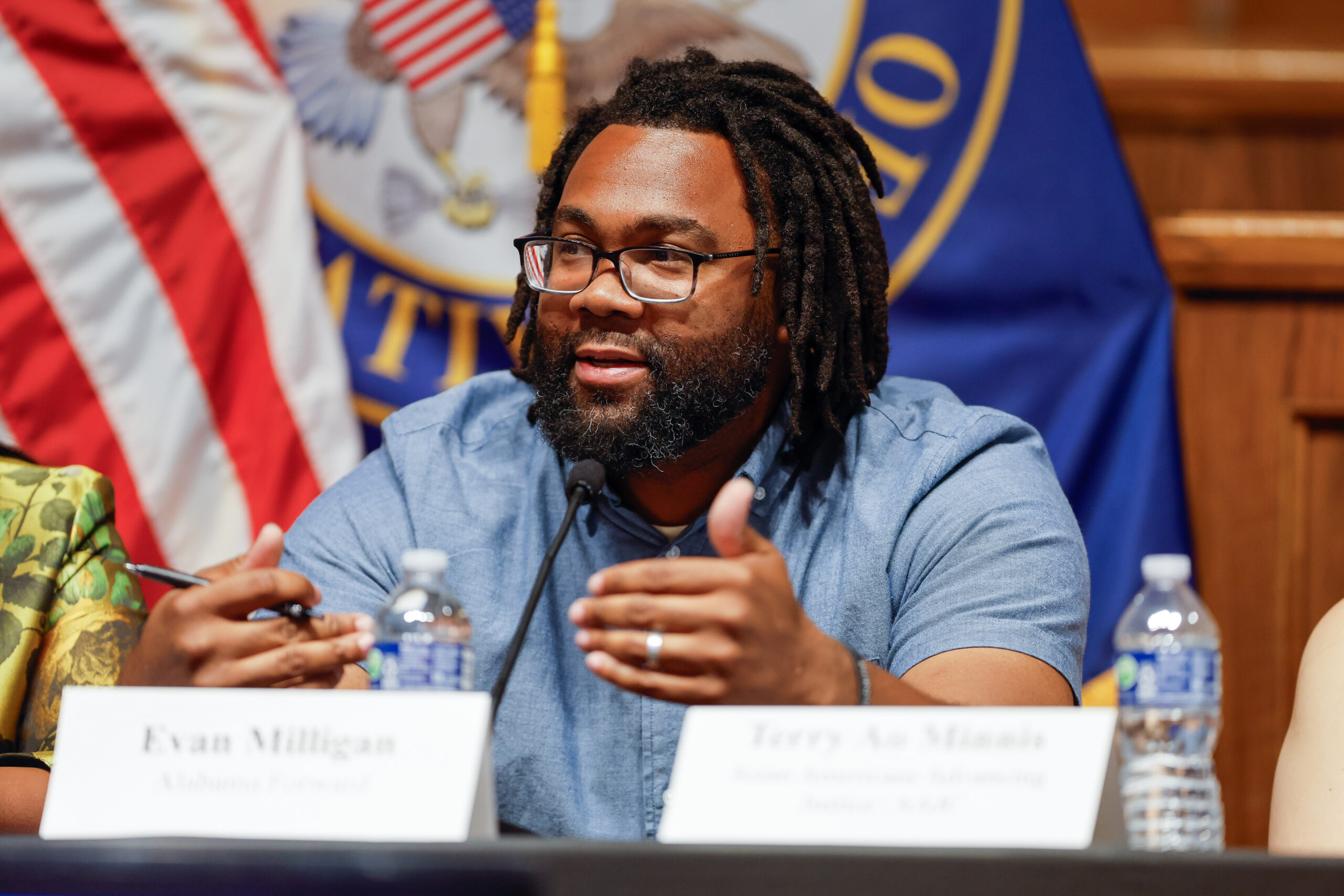
Evan Milligan (Stew Milne/Getty Images for Committee for House Administration)
In a Berlin Church That Hosted Martin Luther King, I Got the Text: ‘We Won’
Evan Milligan reflects on the emotions that swept over him when he learned that he won the U.S. Supreme Court voting rights case with his name on it.
Evan Milligan, 45, is the former executive director of Alabama Forward, a nonprofit, pro-democracy civic engagement network. He was the named plaintiff in the 2023 U.S. Supreme Court case that allowed Alabama to create a second majority-Black congressional district. Here, he reflects on the emotions that swept over him when he learned that he won the U.S. Supreme Court voting rights case with his name on it.
This account has been condensed and edited for clarity.
I was out of the country when we got the decision. I was in Berlin.
I was there with a group called Widen the Circle. They do this trip to Berlin to bring together people working in remembrance in the U.S. and folks doing Holocaust remembrance work in Germany. That remembering side of things is an important part of my training as an activist.
It was the first full day of our trip when I learned about the decision. We were all kind of jet lagged, and we were doing our first walking tour. We were staying in East Berlin — just over the former demarcation line. And the first stop on our tour that morning was in a historically Jewish neighborhood. There’s a Lutheran church there. We were looking at the contrast and history of this neighborhood — this Lutheran church that used to coexist with synagogues.
We’re sitting in there. And they tell us that this is the church where Dr. Martin Luther King Jr. spoke when he visited Berlin, that he intentionally went there. He crossed the wall against the advice of whoever was hosting him, and he spoke at that church.
They’re telling us that when I get a text that says, “We won. We won the case.”
And then I just started crying.
The only person I knew there was Kevin King — he runs King’s Canvas Gallery and Studio here in Montgomery, Alabama. The program invited me, but I said, “I gotta have somebody else from the town to come. It can’t just be one person getting all of these relationships.” So, Kevin was able to come. But everybody else, I’m just meeting them, and I’m sitting there crying.
And that’s because I was getting these images of my dad. My dad died in June of 2021, and that was a traumatizing experience, and I was still in the midst of all of that. There was just a lot of grief tied up with the whole journey.
I had also felt so guilty for being a part of the case, because I feared that my dad’s name — people just called him Milligan as a first name — was going to become synonymous with failure. Dred Scott, Homer Plessy. You attach shame to the names of those men, which is the opposite of what it should be. I was like, “Man, we’re going to be in that boat.” And that’s the last thing he should ever be associated with. This is a guy who should be lifted up.
For us to win — for that to become associated with his name — I was just overwhelmed by emotion. And by where I was physically. We were in Berlin on a cross-cultural exchange. There were Germans processing their families’ association with Nazism. There were Jewish people grappling with inherited legacies and traumas.
And so I explained why this decision mattered. That shaped the tone of our time together — and we ended up going deep in our conversations together.