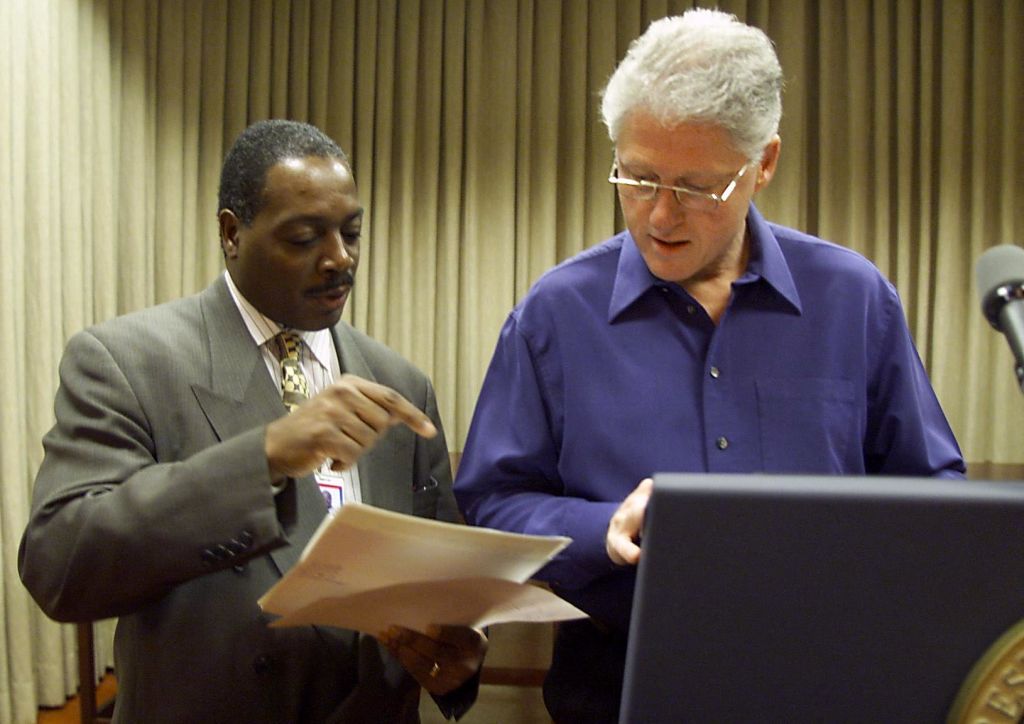
US President Bill Clinton (R) works on his State of Union address with Terry Edmonds Director of White House Speechwriting in the Family Theater of the White House in Washington, DC, 26 January, 2000. Clinton will give the final State of the Union address of his presidency 27 January on Capitol Hill. (Photo by RALPH ALSWANG/The White House/AFP via Getty Images)
I Became the First Black Chief Presidential Speechwriter
Terry Edmonds’ Baltimore upbringing and his love of language led him to the White House in 1995, where he wrote speeches for President Bill Clinton.
Terry Edmonds, 76, grew up in Baltimore, and his love of language was cultivated through books, church, Motown, and Morgan State University. His experiences helped shape the ear that would eventually carry him to the White House. In 1995, Edmonds joined President Bill Clinton’s speechwriting staff and later became his chief speechwriter. As the first Black chief presidential speechwriter, Edmonds helped craft speeches that marked national moments, honored civil rights icons, and carried the voice of a nation. This is the story of how rhythm, memory, and responsibility shaped his work with words.
This account has been condensed and edited for clarity.
I grew up in the projects of Baltimore, raised by my mother, Naomi Parker, and my stepfather, Roland Anthony Parker, who we called Buddy. My mother did everything from substitute teaching to waitressing. My father was a local truck driver who delivered meat around Baltimore to restaurants and other businesses. Neither of them had a college education, but they encouraged me and my siblings to pursue ours.
My mother was a real proponent of HBCUs, especially Morgan State University. She was overjoyed when I was accepted there. But before Morgan, she gave me books. They became an escape from the everyday trauma and reality of growing up in what we then called the ghetto.
I can hear music when I am writing sometimes. I want to make sure whatever I am writing has rhythm. A lot of my understanding of rhythm goes back to church. I sang in the church choir, and my mother did too. Those gospel rhythms were very influential in my life. I was also fortunate to grow up in the 1960s, with Motown all around me — Smokey Robinson, the Temptations, the Four Tops. Smokey Robinson’s songs especially inspired me to write poetry. Later, jazz became a passion: Miles Davis, Herbie Hancock.
Music and writing are definitely related. Even speaking is making music in a way. There is rhythm in what we say. There is logic. There is story.
The pinnacle of my professional writing life was serving as chief speechwriter for President Bill Clinton. I entered the White House in March 1995 and eventually became chief speechwriter. Early on, not long after I started, the great Barbara Jordan passed away. She was very close to President Clinton, and he asked me to help write the eulogy he would deliver at her funeral. I was new to the operation, but this was a major speech for me.
I did not attend the funeral with him, but that evening, he called me. The president called to tell me how much he appreciated what I had given him and how much the people in the audience had responded to those words. For a new White House speechwriter, receiving a call from the president praising my work was unforgettable.
People say the greatest ride in the White House is on Air Force One, and I have ridden on it many times. But even more exclusive is Marine One, the helicopter that only seats a few people.
On May 18, 1997, I rode on Marine One with the president from the White House to Morgan State. I had suggested he give a commencement address at an HBCU. Morgan was right down the street. I said, “Let’s go.” The White House agreed. The president agreed. I helped craft the speech.
The speech President Clinton delivered at Morgan State was about science in the 21st century and how important it would be. In the middle of the speech, I had written a section naming great Morgan graduates like Parren Mitchell and Kweisi Mfume. Then the president said, “And my speechwriter, class of 1972, Terry Edmonds.”
The students were ecstatic. There was so much applause. My family was there. I was deeply touched.
Writers are architects of history. We chronicle what happened, but we are also visionaries. We look forward to what can be. Unless something is written, in many ways, it did not really happen.
As a Black speechwriter, I understood the responsibility. Black voices need to be heard in speechwriting. Our voices need to be heard on affordability, war and peace, economics, education — all the issues that affect us and the world.
And it is an awesome responsibility.